
Nap schedules and transitions can be one of the trickiest parts of baby sleep. One week your baby is happily taking all their naps, then suddenly the next week they’re skipping one, fighting another, and bedtime is shifting all over the place.
As your baby grows, their sleep needs evolve. They’re ready for longer stretches of awake time and more consolidated sleep, which means fewer naps, but longer ones. (yay!)
The confusing and frustrating part is knowing when and how to make the shift.
Guessing, experimenting, and wake window mental gymnastics can take a toll on the whole family during nap transitions, so let’s walk through the four clear signs your baby is ready to drop a nap and what to do about it.

4 signs your baby is ready to drop a nap:
If you’re seeing one of these occasionally, that’s nothing to be too concerned about. But if you’re seeing several signs consistently over time, it’s likely time for a transition.
1. Your baby isn’t tired at their usual sleep times
If your baby is taking a longer time to fall asleep at nap time, rolling around or playing in their crib with little to no interest in settling, that’s a big clue that their current wake window is too short, and they’re ready to spend some more time awake and active. Explore sample nap schedules from newborn to 24 months here.
2. Naps become shorter or less predictable
Short naps happen, but when naps that used to be lengthy and reliable become 30–40 minutes, it can be a sign that your baby’s schedule no longer matches their sleep needs and it's time to make a nap transition.
3. They resist the last nap of the day
This is usually the first and loudest sign. Your baby may be fighting the nap completely, taking forever to fall asleep, or skipping it regularly all together. This makes that final stretch of the day feel a little more chaotic.
On top of a never ending evening, when that last nap disappears, bedtime often gets moved around, which creates a ripple effect into the night and the next day. Instead of a different bed time, it might be time to adjust the nap schedule.
4. Sleep disruptions start showing up at night
Solid naps support consolidated nighttime sleep, so when your baby is outgrowing their current nap schedule, you’ll see some signs throughout the night, not just the day time.
Your baby might start waking up 30-60 minutes after bedtime, they might start having split nights (awake for long stretches with no interest in going back to sleep), and/or wake earlier in the morning.
All of these point to the same thing:
Your baby needs a nap schedule adjustment. They’re ready for more awake time with longer naps and more consolidated sleep. And keep in mind, the longer your baby stays on a schedule that isn’t working, the more exaggerated these symptoms become.
When do babies drop their naps?
Here’s a general guideline for nap transitions:
4 to 3 naps: 4–5 months (around this time, your baby’s sleep cycles are maturing causing what is commonly referred to as the 4 month sleep regression)
3 to 2 naps: 7–8 months (tips for two nap schedules during the 8-10 month sleep regression)
2 to 1 nap: 13–15 months
Dropping naps entirely (or replacing 1 nap with quite time): around 3 years old
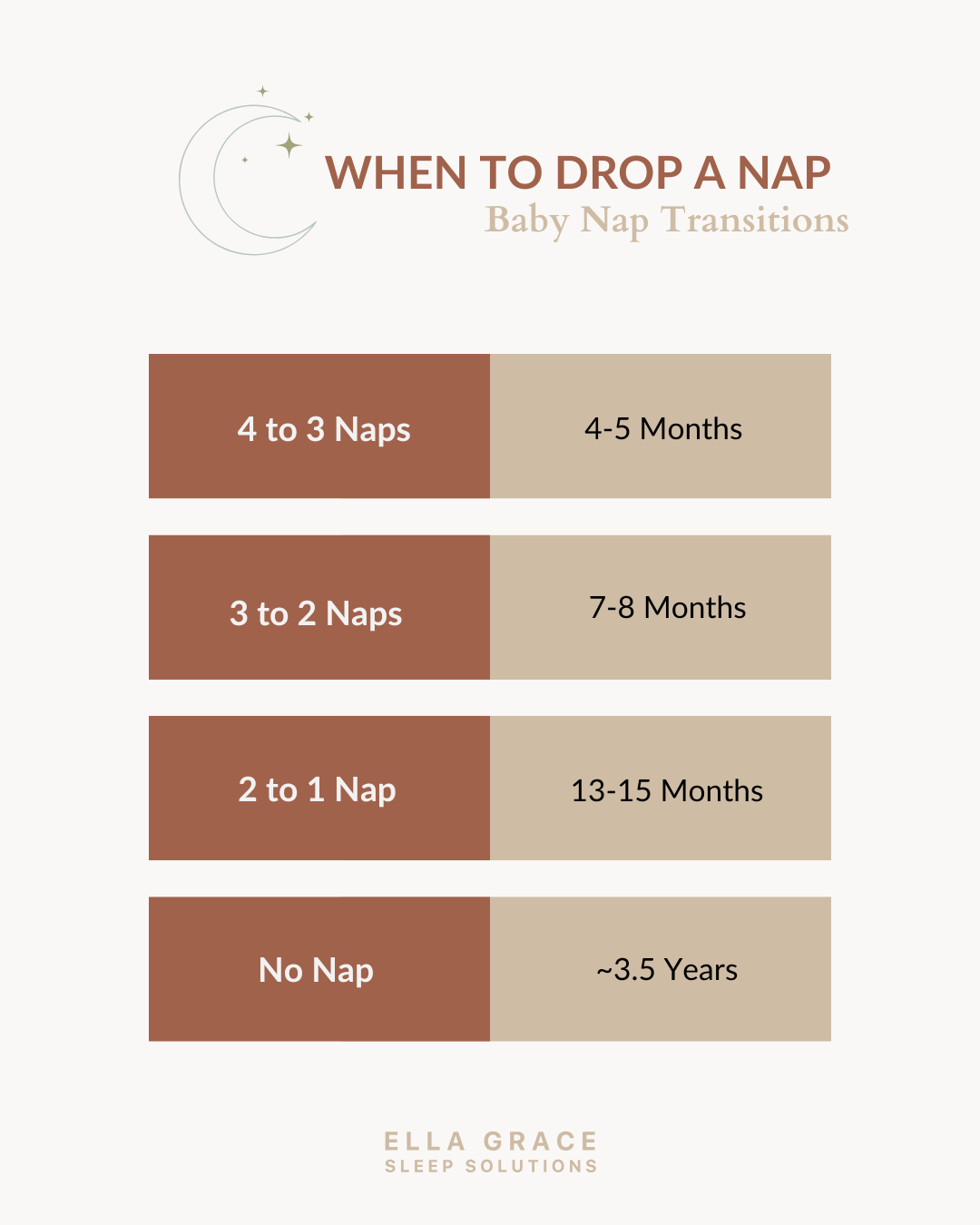
Remember though that these are averages, not hard fast rules. Some babies will shift earlier or later, and that’s totally okay!
False signs your baby is ready to drop their nap:
Not every rough nap day means it’s time to drop one. Before experimenting with nap schedule changes, pause and observe your baby’s patterns for a few days. There might be other factors at play that are disrupting naps or nighttime sleep, like:
Teething or sickness
Traveling
Separation anxiety
Starting daycare or a new caregiver
Gross motor milestones (rolling, crawling, standing, walking)
Babies and toddlers often go through short phases of nap refusal during developmental leaps (often referred to as sleep regressions). That doesn’t mean they’re ready for fewer naps, it usually just means that a big change is happening in their body or brain.
Why nap schedules change as your baby grows:
Sleep needs evolve very quickly in the first year and into toddlerhood.
Newborns aren’t born with organized sleep cycles and can barely stay awake long enough for a feed before falling back asleep. Their wake times are usually driven by hunger, and they don’t have any sense of a circadian rhythm. But fast forward just 8-10 months and they’re crawling, exploring, and staying awake for hours at a time.
As babies grow, their circadian rhythms develop, their sleep cycles mature, and their brain function grows. They become more alert, more curious, and more interactive while they’re awake. As this happens, the total hours of sleep they need in 24 hours decreases, they stay awake longer between naps, and their daytime sleep consolidates into fewer and longer naps. Nap transitions are simply a reflection of that growth.
How much daytime sleep does my baby need?
This is where many parents get stuck. You’ve probably seen charts telling you exactly how much your baby should be sleeping, and when your current reality doesn’t match, it can feel like you’re doing something wrong
The truth is that every child has different sleep needs and naps can be a little tricky.
You can optimize wake windows, feeding, routines, get the merlin suit (which I actually don’t recommend, by the way), crank up the sound machine, and so on, and so on…
But you can’t force your baby to sleep if they don’t need it.
Instead of chasing a perfect schedule, focus on:
Having a daytime flow that works for mom, dad, and baby (and that doesn’t raise everyone’s cortisol levels through the roof)
Making sure naps support nighttime sleep
Babies only need so much sleep in a 24-hour period, and too much daytime sleep can actually make nights harder. Here are general maximums for daytime sleep by age:
3–4 months: 4 hours
5–7 months: 3.75 hours
8–11 months: 3.5 hours
12–18 months: 3 hours
18–24 months: 2.5 hours
2 years: 2.25 hours
Anything less than what’s listed above can still be completely fine (or in the case that your baby has low sleep needs), as long as your baby is happy and sleeping well at night.
How to drop a nap with no drama:
The first step in any nap transition is simple: extend wake time.
This can feel especially hard in the beginning. Many parents might take fussiness as a sign to revert back to the old schedule, but fussiness doesn’t mean your baby can’t handle the transition. It’s just a big change for them at the moment, but their bodies will adjust.
You can help them bridge longer wake windows with:
Snacks or feeding
Getting outside
Putting them in the bath
A change of scenery
Play or sensory activities
From there:
Gradually stretch wake windows in 15 minute increments
Shorten the last nap into a cat nap (if needed)
Bring bedtime earlier when the nap fades out
On a sleep training note, when your baby has learned independent sleep skills, long naps are the norm, which makes nap transitions easier. If you've sleep trained your baby for nighttime sleep, but haven’t applied the same methods at nap time, it might be time to consider sleep training for naps.
Common pitfalls during nap transitions:
The short nap → short wake window cycle
Hanging on to extra naps because naps are short might feel easier in the moment, but it can lead to poor nighttime sleep.
For example, a 5-month-old taking four short naps will benefit from the move to three naps with longer wake windows to encourage longer, consolidated sleep.
Early morning wakings
Early morning wakings are often caused by:
End of the day is too long (like a 2/3/4 schedule)
A nap that’s too early when transitioning to one nap
Not adjusting bedtime during the transition
The biggest trap here is moving up the first nap after starting the day early. This can actually reinforce more early mornings because their bodies stay on the early nap cycle.
During early morning wakes, try to keep the first nap around the same time if possible, so the rest of the schedule isn’t disrupted and continues to support longer stretches of good quality sleep.
Dropping a nap too early
If your baby can’t tolerate the new schedule, it’s not the time to try a nap transition. Instead, slightly adjust the current schedule to fit their sleep needs.
For example: Many parents might expect their 12 month old to be ready to make the 2 to 1 nap transition, but 13-15 months is actually more age appropriate.A 12-month-old who isn't quite ready for one nap may stay on two naps by capping the first nap to preserve the second.
How to fix your baby’s sleep schedule:
Typically, a nap transition shouldn’t take longer than two weeks, but if sleep feels completely off-kilter because of a nap transition, go back to the sleep basics:
Start the day at the same time each morning
Keep naps around the same time each day with a clock-based schedule
Aim for a consistent bedtime window
Assess total sleep and make sure they’re not getting too much daytime sleep
Reevaluate the number of naps
A simple structure creates predictability, and predictability supports sleep.
Nap transitions are hard, but the only way out is through.
It’s a right of passage. Your baby is growing, changing, and moving toward more mature sleep, and you can absolutely support them through it.
If you focus on patterns (not one-off rough days), stay consistent, keep the schedule supportive, and take a deep breath here and there, these transitions become much smoother. Promise!
For more nap time resources and sample sleep schedules by age, explore my Master Sleep Schedule Chart.
To better sleep,
Ella