
How to sleep train twins: getting your babies to sleep at night
There really should be an award for parents with twin babies. You absolutely get double the love, but you also get double the wakings, double the feedings, double the diapers, double the financial responsibility, and double the mental load.
So it should be no surprise that parents of twins or multiples, mom or dad, have an increased chance of postpartum depression, anxiety, or other mental health problems compared to parents of singletons.
That includes sleep deprivation.
You can’t rock two babies all night, and if your twin babies are on two different schedules, there quite literally is no break. No such thing as “sleeping when the babies sleep.” At some point, twin sleep reaches a breaking point and you need a sustainable plan.
The good news is that it’s absolutely possible to sleep train twins and get them sleeping well, both overnight and during the day. When sleep is twice as hard to come by, the benefits of sleep training your twins also doubles. So let’s talk about how we get there!
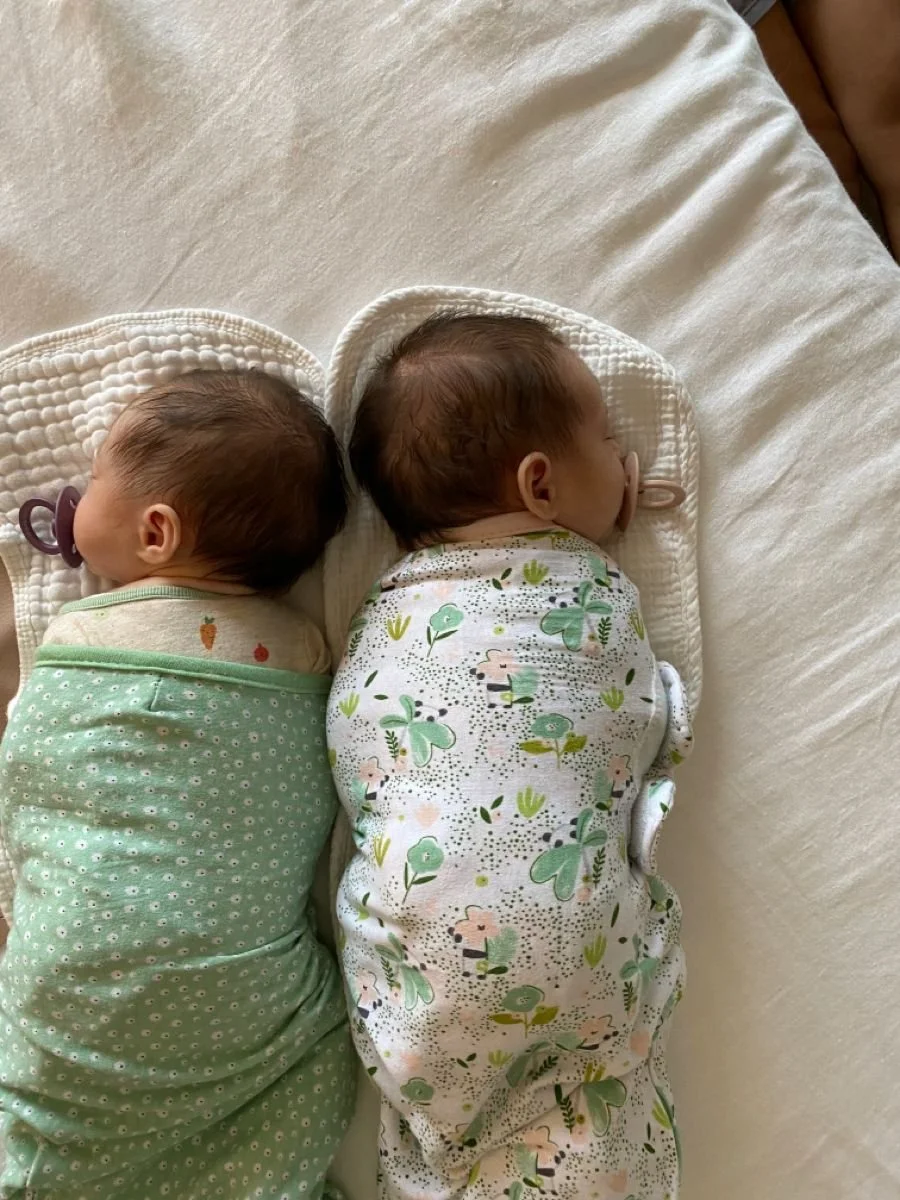
How to get twins to sleep through the night & when to start sleep training:
When we talk about how to sleep train twins, we’re really asking:what needs to be in place for any baby to sleep through the night? Twin or singleton.
I like to think of this as three core pillars:
1. Full feeds during the day
For babies to sleep longer stretches overnight, they need to be getting their caloric needs met during the day.
That usually means:
Feeding consistently throughout the day (within the 12–13 hour window)
Gradually shifting calories from overnight feeds to daytime feeds when appropriate
Supporting strong, full feeds (rather than frequent snacking)
If your 3 or 4 month old baby still need calories overnight, they will wake for them, and that’s totally normal. You can absolutely keep one easy night feed and still enjoy a peaceful bedtime and long stretches of sleep. But when they’re ready, we can gently wean night feeds by redistributing those calories during the day.
2. Daytime sleep that supports nighttime sleep
Naps matter more than most parents think. The right number and timing of naps support consolidated nighttime sleep.
If naps are:
Too long or too short (aka, the dreaded 30-minute naps)
Not evenly spaced throughout the day
Inconsistent times, like a shifting morning nap for example
…it can absolutely impact overnight sleep.Even if your babies are independent sleepers and getting plenty of calories during the day, if naps are off, it’s more difficult for them to settle into sleep and stay asleep.
To support better (not perfect) nighttime sleep, we want to focus on:
The right number of naps for your babies’ age. Are your babies still on 3 or 4 naps a day, or are they ready for a 3-to-2 nap transition?
Naps happening around the same time each day
When naps are working, babies are able to settle for nighttime sleep without being exhausted and have the right amount of sleep pressure to fall asleep and stay asleep at night.
When sleep training for naps, establish a predictable, age-appropriate nap schedule and gradually move towards a clock-based schedule, with naps happening around the same time each time.
3. Independent sleep skills
Night wakings are incredibly normal!Babies stir and wake in between sleep cycles and in lighter phases of sleep. Babies who are confident in their cribs and know how to fall asleep independently can get themselves back to sleep when they wake up at night.
This is where sleep training becomes KEY for better sleep.
If your babies rely on feeding or nursing to sleep, rocking to sleep, or being held to sleep, they’ll often need that same support each time they wake overnight. These are called sleep associations.
Independent sleep associations: Things that help your babies make the transition from awake to sleep by themselves, like a crib, white noise, pacifier, sleep sack, or a dark room.
Dependent sleep associations: Sleep cues that require parental involvement, like rocking, nursing, or holding. With these associations, the parent is always responsible for the transition from awake to asleep instead of your babies.
Introducing independent sleep associations help babies settle into sleep on their own, get back to sleep between sleep cycles, and sleep for longer, more consolidated stretches
Short rocking, patting, or gentle back rubs in the crib are good alternatives to the more dependent sleep associations like feeding or holding to sleep. You can start with extra support with physical reassurance, then gradually move to using just verbal reassurance and then stepping out of the room.
Some babies do well with a mix of space and reassurance (like popping in every 5-10 minutes), while others do better with more hands-on comfort at the start of the transition.
Remember, this process might bring up some hard feelings for everyone. It’s totally natural for your baby to be upset during this transition, but with steady support and willingness to hold space for your baby’s reaction, your baby will become comfortable with the new routine.
What age to start sleep training twins:
You can begin introducing independent sleep routines as early as 12 weeks adjusted.
Most babies at 3, 4, and 5 months are ready to learn independent sleep skills. The ability is there, but we need to know what to expect when sleep training 3 month old babies versus 5 month old babies.
For twins, this is especially important to consider through the lens of adjusted age, since many twins are born prematurely.
For example, If your babies are 16 weeks old but were born 4 weeks early, their adjusted age is 12 weeks. In that case, you would use 12 weeks adjusted as your starting point.
Most 3 month old babies will still need at least one night feed and their naps are still a bit unpredictable.Sleep training at three months can certainly be a huge gift to families, but your goals might look more like this:
predictable middle-of-the-night feeds
potentially short but peaceful crib naps
babies who fall asleep independently
And an evening to yourselves that doesn’t involve endless holding or rocking to sleep
instead of:
no night feeds
long, perfect crib naps
a predictable, clock-based schedule
So when can I drop night feeds for my twins?
This depends.
Every baby is different, but some 3-month-old twins genuinely need one feed overnight to meet their daily caloric needs. Cutting out a night feed for babies who still genuinely need it won’t work.
By 5–6 months, most healthy twin babies are capable of sleeping through the night without feeding, but their readiness still depends on:
Feeding efficiency or difficulties
Total daytime intake
Growth and development
Cutting out night feeds cold turkey works well for babies who are great daytime eaters, but if one or both twins are having a hard time adjusting, gradually shifting calories to daytime hours by weaning one night feed at a time might work best.
Nap training for twins:
Nap training twins at 3–4 months can be a bit dicey.
At this age, babies are just beginning to learn how to settle in their cribs, so naps are often short, typically one sleep cycle, and around 30–40 minutes. This is completely normal for younger infants so it can make it a little more difficult to find a structured schedule.
By 5 months, babies start to move toward three naps a day, making it easier to have a structured schedule with naps happening at the same time for both babies, with two longer morning naps.
However, for twin families, there’s always something to juggle, whether it's feeding, cleaning, holding babies, the list goes on and on. So nap training often becomes a priority pretty quickly. 5-6 months can sound like an eternity away when you never get a break.
That being said, at 3 months, starting with solidifying just the first nap of the day can make the process feel more manageable. In the meantime, stroller naps or contact naps can be helpful tools to bridge the gap. Don’t underestimate the power of a good stroller nap in the fresh air for the whole family!
Should twins nap in the same room?
You have two options:
Option 1: Separate during the learning phase (preferred)
This is often the most effective approach. Separating twins during nap training can:
Reduce stimulation and distraction
Allow each baby to learn independently
Lead to faster, smoother progress
Once naps are established, you can move them back into the same room.
Option 2: Keep them together
This also works, but it may take longer and require more patience, especially if one baby protests naps more than the other.
At night however, twins can (and typically should) sleep in the same room if that’s your long-term goal. Twins find comfort in the other’s presence, even during the sleep training process.
Tips for nap training each twin:
Prioritize the independent napping skill over a perfect schedule.
When you’re in the early stages of nap training, your babies might fall asleep for 25 minutes or they might fall asleep later than expected. That’s okay. That’s part of the process. The most important thing is that they’re learning how to fall asleep.
Once they’ve got that down, nap length and consistency will fall into place.
If one baby or both babies are still awake after 60 minutes of trying to nap:
Open the blinds and get them up.
Offer a short wake window– around 30 to 60 minutes depending on age.
Offer a feed (if aligns), chill, and try again.
This helps reset nap time. And over time, your babies will start connecting the dots.
Create a wind-down routine.
This doesn’t have to be elaborate, but something like:
Go into their room
Close the blinds
Fresh diaper, sleep sack
White noise on
Read a book or sing a few songs
Lights off, into crib
You can also start to slow things down in the 10-15 minutes before this. Dim the lights, quiet your voice, and put away noisy toys.
Get a full feed in, but don’t feed to sleep.
A lot of families ask if they can still feed before a nap when nap training, and yes! You absolutely can. In fact, it can be helpful for longer, more restorative naps. Just don’t feed them to sleep.
To move toward independent sleep, you’ll want to break the association that sleep only happens while feeding. Try feeding 10-15 minutes before nap time so they won’t wake up from hunger, but they aren’t relying on a feed to fall asleep.
Bedtime is the best time to build independent sleep skills.
The drive to sleep is strongest at the end of the day. Your little one’s body is naturally producing melatonin, the temperature is cooling, and the environment is darker and quieter than the middle of the afternoon. Work on these independent skills each night, and eventually they will translate to daytime sleep.
Sleep training options for twins:
When it comes to sleep training twins, there are several approaches you can take, but you want to make sure it works for your family. Some options include:
Timed checks
A structured approach where you:
Put baby down awake
Return at regular intervals to offer reassurance
Gradually increase independence
Crib-side support
A more gradual method where you:
Put baby down awake
Stay close to the crib
Offer physical reassurance
Slowly reduce your presence over time
Both approaches can be effective. The most important factor is choosing a method you can consistently follow through on.
Sleep training methods can be a divisive topic. Your twin babies have sleep needs, but you also have sleep needs!If you’re worried about sleep training, a balanced approach exists that sets whole family wellness as the main goal.
Creating sleep routines for twin newborns:
With twins, routines are essential to everyone’s well-being. Taking care of just one baby without solidified routines is not sustainable, let alone two.
When getting your newborns on a routine, focus on:
Feeding both babies at the same time every three hours. This will keep them satisfied at the same time and help “tank them up” during daylight hours, making sure their longest stretches of sleep happen at night instead of during the day. If one twin gets hungry slightly earlier than the other, feed both.
Keeping naps aligned as much as possible. Newborns are easily overstimulated, and overtired babies have a harder time falling and staying asleep. Stick to age-appropriate wake windows, watch for their sleepy cues, and put them down as close to the same time as possible. Wake one baby if needed.
Creating a simple, repeatable bedtime routine. For example: feed, diaper change, swaddle, short song or book, into the crib.
Keeping twins on the same schedule:
Even though twins are individuals with different temperaments and sleep needs, they need to be on the same general schedule.
That means:
Feeding at the same time
Napping at the same time
Waking at the same time
Yes, one baby may be the “easier” sleeper. And yes, you can make small adjustments to support each baby, but the overall rhythm should stay aligned. Otherwise, the day becomes unsustainable very quickly.
For example, if twin A is an easier sleeper, use that to your advantage when creating a schedule. The schedule might lean more towards twin B's sleep needs because twin A can more easily adapt to that schedule.
Practical tips for twin sleep success:
A few things that make a big difference for twin families:
Prep ahead of time: bottles made, feeding stations set up, pajamas ready for after bath
Find feeding systems that work: tandem feeding, propped bottles, or alternating
Simplify routines: the more repeatable, the better
Think like a leader: your babies (and you!!) need lots of structure. Taking care of twins can feel like sheer survival, so holding boundaries, setting rhythms, and being the calm effective leader your family needs is essential to everyone’s wellbeing.
And most importantly, give yourself grace.
So when is the best time to sleep train twins?
As mentioned earlier, most babies can start to learn independent sleep skills by 3 months (adjusted age). But because sleep training twins can be trickier than one, the best time to sleep train twins is when your family has the capacity to follow through.
Sleep training requires consistency, patience, and emotional energy.
For twin families, the question of sleep training often comes up earlier, not because you’re rushing it, but because you need a sustainable system.
And when that system actually starts working for your family, regardless of your method, it’s truly life-changing.
Sleep training isn’t a one-size-fits-all because no two families are alike, especially families with twins.
If you’re ready to create sustainable sleep routines that will have the whole family well rested, whatever stage your twins are in, let’s book a consultation call! I’d love to support you in any way I can.